Santa Muerte (literally Holy Death or Saint Death) tattoos are extremely popular among the Mexican people. Santa Muerte (also known as Santisima Muerte, Se�ora de las Sombras (Lady of the Shadows), Se�ora Blanca (White Lady), Se�ora Negra (Black Lady), Ni�a Santa (Holy Girl), La Flaca (The Skinny One), Santa Sebastienne, etc) is the beloved goddess of death who's origins date to the pre hispanic period of Mexico.


The origins of the myths of Santa Muerte aren't completely clear, but is quite obvious that the cult of Santa Muerte is a syncretism between Mesoamerican and Catholic beliefs. Mexican culture since the pre-Columbian era has maintained a certain reverence towards death, which can be seen in the widespread Mexican celebration of the Day of the Dead. Death became personified in Aztec and other cultures in the form of humans with half their flesh missing, symbolizing the duality of life and death.

In the pre-Columbian Aztec religion, the realm of the souls of the people who died from natural causes (of old age, diseases, etc) was Mictlan, the lowest and northernmost section of the underworld. Mictlan was ruled by a king, Mictlantecuhtli (Lord of the Underworld) and his wife, Mictecacihuatl (Lady of the Underworld).

Mictecacihuatl was not only the Queen of Mictlan, but was also the protector of the souls residing in the dark underworld (some legends claimed that she was the goddess in charge with the bones of the dead). She also presided over the ancient festivals of the dead, which evolved from Aztec traditions into the modern Day of the Dead (in spanish el Dia de los Muertos) - originally a holiday which fell at the end of the month of July and the beginning of August and was dedicated to the children and the dead.

The persons who died by natural causes were interred with grave goods, which they carried with them on the long and dangerous journey to the underworld. Upon arrival in Mictlan these goods were offered to Mictlantecuhtli and his wife, Mictecacihuatl. Many of the offerings given then are the same as those offered to Santa Muerte today.


Mictlantecuhtli (left) and Mictecacihuatl (right)


After the Spanish conquest of the Aztec Empire, the worship of death diminished but was never eradicated, and the Day of the Dead remained one of the most important mexican festivals. In contrast to the Day of the Dead, due to the fact that the Catholic Church has labeled Santa Muerta as a death cult, claiming it has ties to satanism, the worship of Santa Muerte remained hidden until the 19th century. When it surfaced, reaction was often harsh, requiring the burning of any image found.

The religion of Santa Muerte was born in the middle of the 20th century, and at the very beginning was clandestine and closely associated with crime. However, in the past decades, original Santa Muerte's followers (such as thieves, pickpockets and street drug dealers) have merged with thousands of ordinary Mexican Catholics who had become disillusioned with the rigid behaviour of the Catholic Church and its insufficient reflection of life in the modern Mexican society. The Santa Muerte veneration, offering a spiritual way out of hardship, has rapidly expanded. The number of believers has grown to approximately two million followers and the new religion has crossed the borders.


photos taken during the ritual of 'Santa Muerte'


Although the Roman Catholic Church has denounced the worship of Saint Death, considering it as a black magic and the Santa Muerte's followers as devil worshippers, the devotees have never given up their Catholic faith. Santa Muerte figurines often stand near the statues of Jesus Christ or the Virgin of Guadalupe because the devotees to Santa Muerte do not see any contradiction between the Catholic faith and the worship of Santa Muerte. In many ways, a ritual dedicated to Santa Muerte is very similar to a Catholic rite, including procession and prayers for power healing, protection and favors.

Some worshippers make the last part of the pilgrimage to the shrine on their bloodied knees and many of them smoke marijuana that has a strong relation to Saint Death. Before the rosary is prayed collectively at the end of the day, they leave offerings (money, candies, tabacco, flowers and candles) and make petitions to �La Sant�sima Muerte�, who is reputedly a very powerful saint and can make life-saving miracles.


To be continued...

"If you can't spell, you should think twice before get a text tattooed on your body!" I think that this piece of advice should be written at the entrance of every tattoo parlor. Obviously, there are plenty of those who don't care about this simple rule.


misspelled tattoo on the forearm: I was mayd for you
Because of the misspelled word "mayd" the meaning of this tattoo is a bit ambiguous: it's a king of love statements or this person claims that he / she used to work for the so-called "Maid for you" company?


misspelled tattoo on the back: awsome
He's Awsome. Not awesome, only awsome. I could't find this word in the dictionary so I suppose that Awsome is his name. Now, if you meet this dude and he tries to impress you by showing off his awesome tattoo you should say something like that: "Hello, Awsome! Nice to meet you!"


failed tattoo: misspelled tattoo
... and she means it: she chose a ridiculous misspelled tattoo instead of a regular, boring one.


failed tattoo / misspelled tattoo: belive in myself
This dude belive in himself. Too bad you didn't believe in your teachers, mate! I bet they can spell a lot better than you


failed tattoo / misspelled tattoo: beliefe in dreams
"Beliefe" in dreams; too bad he / she doesn't believe in grammar.


failed tattoo / misspelled tattoo: belife makes things real
This is deep philosophy, indeed. How about this one: misspellings make tattoos to look really stupid


Anyway, if you think that a misspelled tattoo is the most embarrassing kind of tattoo, you're wrong. To hire a Scratcher (an amateur or unskilled tattoo artist) is a is a much better way to get an embarrassing tattoo. Just look at the next five photos and you'll totally agree witth me:


failed tattoo: ugly baby
Mummy's little adorable sweetest cutest creepy baby


failed tattoo: ugly little girl
Is something wrong with the artist who made the tattoo? Or maybe the tattoo is a very accurate image of the little girl's evil side.


failed tattoo: ugly little boy
Do you remember that old game "find 10 differences between two images. Here's an improved variant: find 100 differences between the photo and the tattoo. Or - even more difficult - try to find 3 similarities between the tattoo and the photo


failed tattoo: ugly woman
Well, unlike the previous images, this time I don't have a photo to compare with the tattoo, so I cannot say if the tattoo artist a really unskilled one, or - even worse - poor Wendy looks just like that.


failed tattoo: two ugly children
I suppose those lovely little children are Wendy's kids. If you're wondering who's Wendy look the image above :)


Similar posts:
Failed tattoos: misspelled tattoos 1
Failed tattoos : misspelled tattoos 2

The tattoo in the picture below is often given as an example of a failed tattoo (I've founded the same confusion even on hanzismatter.blogspot, a blog which belongs to someone who seems to have vast knowledge of Chinese and Japanese languages).

ideograms tattoo - chinese meaning = fool, sucker; japanese meaning: Akiko - a very popular female name

If we consider only the Chinese reading of these characters, the tattoo's meaning is "fool, sucker" - ? (pronunciation: dai with the first tone) = dull; dull-minded, simple, stupid; ? (pronunciation: zi with the third tone) = offspring, child; together they form the word ?? (daizi) which means "fool, stupid, sucker".

On the other hand, in Japanese ?? is just one of the nearly 300 ways (I know, it's hard to believe that there are really that many) to write the popular name "Akiko".

In conclusion, this is not (such) a failed tattoo.

Similar posts:
Stupidity is painful

Another failed kanji / hanzi tattoo

A cool guy... or a bad woman?

Tattoos fails: kanji / hanzi mistakes

He has hemorrhoids... and he is proud with that

Failed tatoos: Kanji mistakes - the seven virtues of the samurai

Daniel got his diehard mouse today. 


I've often heard that stupidity is painful - and recently I found the proof. For the beginning, let's keep in mind two facts about tattoos:

1. Getting a tattoo is a pretty painful process.
2. It's really silly to get a Kanji / Hanzi tattoo without getting informed about the Kanji / Hanzi 's meaning.

Now, with this two things in mind, let's take a look at this tattoo:


The very first problem is that the top character is upside down. But that is just a small problem.

The real problem is the meaning of these ideograms:

The the top character (?) means "pain; suffering; distress; anxiety; trouble".
The next two ideograms (??) mean "fool; simpleton; idiot".

The tattoo's meaning is something like "suffering idiot" or "a fool in pain" or "distressed simpleton" or something of this kind.

In conclusion, stupidity is really painful.

Similar posts:
Another failed kanji / hanzi tattoo

A cool guy... or a bad woman?

Tattoos fails: kanji / hanzi mistakes

He has hemorrhoids... and he is proud with that

Failed tatoos: Kanji mistakes - the seven virtues of the samurai

Some basic creatures that I haven't seen for a long long time.


This tattoo is based on a painting that I did a while ago.
One of my customers liked the painting and the idea to represent as Nekomata his 10 years old cat. That's why I made some changes to make this design more suitable. 
Some parts are fresh and some are healed.


Related posts:
Death tattoos: angels of death - themes and representations (2)
Death tattoos: angels of death - themes and representations (1)
Death tattoos: angels of death (1)


Angel of Death tattoo on the back: the Angel of Death offering a rose to a child
Angel of Death tattoo: the Angel of Death offering a rose to a child


arm tattoo: Angel of Death / Grim Reaper
forearm tattoo: Angel of Death wearing a hooded cloak; with one hand he is carrying the famous Grim Reaper's scythe and in the other hand is holding a skull; the angel's face is hidden by the cloak's hood and cannot be seen


shoulder tattoo: Angel of Death / Grim Reaper
shoulder tattoo: Angel of Death


Death tattoo on the back: Grim Reaper with skeletal wings
Grim Reaper / Angel of Death tattoo; in this tattoo Grim Reaper is depicted as an winged skeleton wearing a ragged cloak


Angel of Death tattoo: compassionate Angel of Death
Angel of Death portrayed as a good angel who put an end to the suffering of those who need help


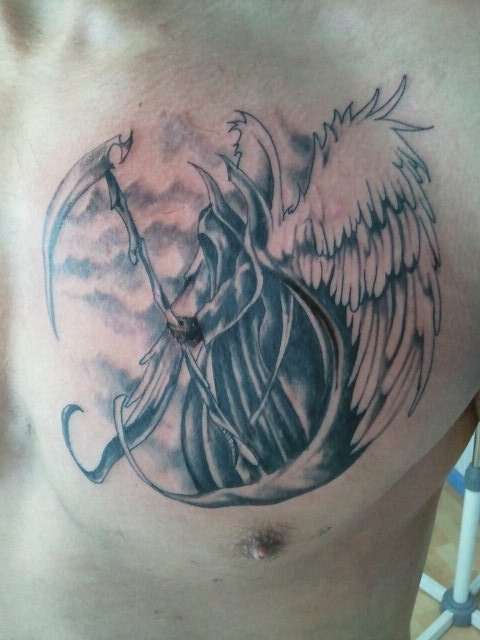
chest tattoo: Angel of Death / Grim Reaper depicted with archangel-like feathered wings
chest tattoo: Grim Reaper depicted with archangel-like feathered wings


tattoo covering the shoulder and the upper arm: Angel of Death / Grim Reaper depicted with archangel-like feathered wings
shoulder tattoo: Grim Reaper depicted with archangel-like feathered wings


full-back tattoo: Angel of Death holding a human skull
Full-back tattoo: Angel of Death holding a human skull in his / her hands. The angel has giant feathered wings and is wearing monastic clothes.


arm tattoo: Angel of Death portrayed as a winged warrior-monster
Angel of Death portrayed as a winged warrior-monster


arm tattoo: Angel of Death portrayed as a blindfolded little girl with giant black feathered wings
arm tattoo: Angel of Death portrayed as a blindfolded little girl


arm tattoo: Grim Reaper / Angel of Death portrayed as a hideous skeleton with giant bat-wings


tattoo on the back: Angel of Death portrayed as a winged young woman
Angel of Death portrayed as a winged young woman


shoulder tattoo / upper arm tattoo: Grim Reaper / Angel of Death portrayed as a winged warrior-skeleton
Grim Reaper / Angel of Death portrayed as a winged warrior-skeleton


Depending on the artist's vision, various elements of an "Angel of Death" tattoo may vary significantly.

Angel of Death's face:

angel of the death portrayed as a expressionless woman
expressionless Angel of Death

1. For some people, the Angel of Death is an ancient, powerful being that is neither good nor evil, but simply neutral. It is his job is to keep the cosmic balance leveled. Death claims the souls of those who die and takes them to the afterlife. It is useless to fight him as he cannot be destroyed for there is always death, there is only life because of death. The Angel of Death cannot be stopped and never gives up a claim; he (or she) cannot be bribed, tricked, or outwitted in order to retain one's life. In accordance with this belief, the Angel of Death's face is beautiful but expressionless.


Grim Reaper / Angel of Death portrayed as an evil angel
Angel of Death portrayed as an evil angel

2. If the Angel of Death is portrayed as an evil angel (a fallen angel) his (her) face will contain various demonic features such as red or black horns upon the forehead, reddish skin / ragged skin, dark eyes (or empty eyes), a devilish grin, etc.


angel of death tattoo: a compassionate angel of death
Angel of Death portrayed as a good angel

3. The Angel of Death can be portrayed as a good angel who put an end to the suffering of those who need help, situation when obviously the angel has a tender and compassionate face.


Grim Reaper / Angel of the Death
Angel of Death portrayed as an evil skeleton

4. Sometimes the Angel of Death is depicted as an winged skeleton. Usually, the skeleton's face has an evil expression: a malefic grin, burning eyes, etc.


Grim Reaper / Angel of Death tattoo: winged angel of death wearing a hooded black cloak
faceless Angel of Death

5. Occasionally (especially when the Angel of Death is depicted as wearing the famous Grim Reaper's hooded cloak) the face of the Angel of Death is partially or completely hidden (by the hood of the cloak).


The wings

Most commonly, the Angel of the Death is depicted with long, large, archangel-like feathered wings. The color of the wings can vary according to the main theme of the tattoo: the wings can be white, white with shades of light blue (when the Angel of Death is a good angel), black (probably the most common color), black and white, black and white with shades of gray, reddish, yellow-gold, etc. Although in the most cases the Angel of Death has archangel-like feathered wings, there are many tattoos (especially when the Angel of Death is depicted as an evil angel)that the Angel of Death has demon wings, giant bat-wings, skeletal wings, etc.

Grim Reaper - Angel of Death tattoo; angel of death with huge feathered wings
faceless Angel of Death with white feathered wings

Angel of Death / Grim Reaper wearing the famous black cloak
faceless Angel of Death with black feathered wings

Grim Reaper - Angel of Death tattoo - a skeleton with huge bat-wings
Grim Reaper / Angel of Death with bat wings

Angel of Death tattoo - Angel of Death depicted as a winged warrior
evil Angel of Death with monster-like wings

Grim Reaper tattoo - Grim Reaper with skeletal wings
evil Angel of Death with skeletal wings


The weapon

Regarding the weapons, the tattooers have only two choices: the sword (usually highly decorated; the most common choice) or the Grim Reaper's scythe.

Grim Reaper tattoo / Angel of Death tattoo covering the shoulder and the upper arm
Angel of Death carrying the famous scythe

Grim Reaper portrayed as a warrior-skeleton with wings
Angel of Death holding a highly decorated sword


The clothes:

Regarding the clothes, there are not too many constraints, so that tattooers can unleash their imagination. The angels of death are depicted wearing monastic clothes, hooded cloaks, ragged clothes and even chained tunics and breastplates (when the Angel of Death is portrayed as an warrior angel).

Grim Reaper / Angel of Death tattoo on the arm
Angel of Death wearing a hooded cloak

Angel of Death - full back tattoo
Angel of Death portrayed as a young woman wearing sexy clothes

full back tattoo - Angel of Death holding a human skull
Angel of Death wearing monastic clothes

warrior Angel of Death
warrior Angel of Death wearing a breastplate

Related posts:
Death tattoos: angels of death - themes and representations (1)
Death tattoos: angels of death (1)
Angel of Death tattoos: examples and ideas
Death tattoos: the main depictions of the Grim Reaper
Death Tattoos / Grim Reaper Tattoos: themes and meanings

Copyright © 2013 Girls tattoos, tattoo styles, tattoo artists and tattoo shops