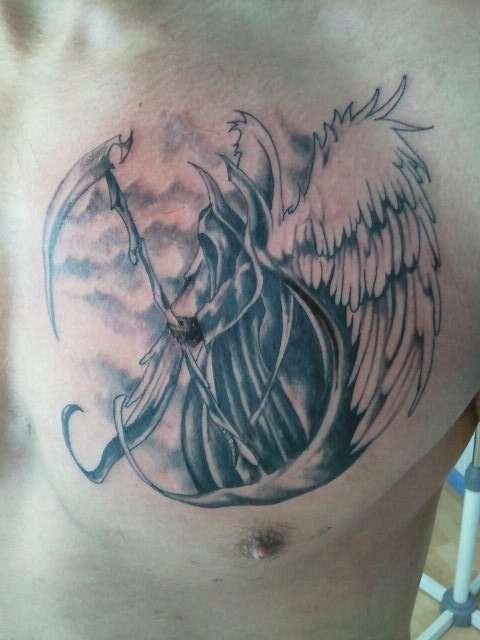
Some basic creatures that I haven't seen for a long long time.





Depending on the artist's vision, various elements of an "Angel of Death" tattoo may vary significantly.

1. For some people, the Angel of Death is an ancient, powerful being that is neither good nor evil, but simply neutral. It is his job is to keep the cosmic balance leveled. Death claims the souls of those who die and takes them to the afterlife. It is useless to fight him as he cannot be destroyed for there is always death, there is only life because of death. The Angel of Death cannot be stopped and never gives up a claim; he (or she) cannot be bribed, tricked, or outwitted in order to retain one's life. In accordance with this belief, the Angel of Death's face is beautiful but expressionless.

2. If the Angel of Death is portrayed as an evil angel (a fallen angel) his (her) face will contain various demonic features such as red or black horns upon the forehead, reddish skin / ragged skin, dark eyes (or empty eyes), a devilish grin, etc.

3. The Angel of Death can be portrayed as a good angel who put an end to the suffering of those who need help, situation when obviously the angel has a tender and compassionate face.

4. Sometimes the Angel of Death is depicted as an winged skeleton. Usually, the skeleton's face has an evil expression: a malefic grin, burning eyes, etc.

5. Occasionally (especially when the Angel of Death is depicted as wearing the famous Grim Reaper's hooded cloak) the face of the Angel of Death is partially or completely hidden (by the hood of the cloak).
Most commonly, the Angel of the Death is depicted with long, large, archangel-like feathered wings. The color of the wings can vary according to the main theme of the tattoo: the wings can be white, white with shades of light blue (when the Angel of Death is a good angel), black (probably the most common color), black and white, black and white with shades of gray, reddish, yellow-gold, etc. Although in the most cases the Angel of Death has archangel-like feathered wings, there are many tattoos (especially when the Angel of Death is depicted as an evil angel)that the Angel of Death has demon wings, giant bat-wings, skeletal wings, etc.


Regarding the weapons, the tattooers have only two choices: the sword (usually highly decorated; the most common choice) or the Grim Reaper's scythe.


Regarding the clothes, there are not too many constraints, so that tattooers can unleash their imagination. The angels of death are depicted wearing monastic clothes, hooded cloaks, ragged clothes and even chained tunics and breastplates (when the Angel of Death is portrayed as an warrior angel).


Related posts:
Death tattoos: angels of death - themes and representations (1)
Death tattoos: angels of death (1)
Angel of Death tattoos: examples and ideas
Death tattoos: the main depictions of the Grim Reaper
Death Tattoos / Grim Reaper Tattoos: themes and meanings
Below you can find a non-exhaustive list containing the main representations of the "Angels of Death" in tattoos:

Mostly, the Angel of Death is depicted as a slim, dark and particularly beautiful young man or young woman. Unlike the Grim Reaper, the Angel of Death is depicted with wings (usually giant archangel-like wings).

The identity of the Angel of Death is indicated by the presence of certain elements: the long scythe, the presence of the human skulls, the presence of a dying human being, etc. Sometimes, the Angel of the Death is wearing the famous Death's hooded black cloak.
Very often, the image of the Angel of the Death results by the fusion of the elements belonging to different characters: angels and Grim Reaper, angels and demons, angels and skeletons, etc.

As a result of the influence of the Scandinavian mythology, the Angel of Death is often depicted as a winged warrior:


Related posts:
Death tattoos: angels of death - themes and representations (1)
Death tattoos: angels of death - themes and representations (2)
Angel of Death tattoos: examples and ideas

Although Grim Reaper is the most common theme for the so-called death-tattoos, there are many people who choose a different representation of the Death: skeletons, demons, monsters, etc. One of the most popular choices is the "Angel of Death" theme.
The origin of the representations should be sought in the ancient religious texts (the Bible and the rabbinical literature). In these texts, there is no just one Angel of the Death.
Angel of the Death was created by God on the first day. He has twelve wings and is full of eyes. In the hour of death he stands at the head of the departing one with a drawn sword, to which clings a drop of gall. As soon as the dying man sees the angel, he is seized with a convulsion and opens his mouth, whereupon the angel throws the drop into it. ('Ab. Zarah 20b;) The expression "the taste of death" originated in the idea that death was caused by a drop of gall.
The Memitim - a type of angel from biblical lore associated with the mediation over the lives of the dying. The name is derived from the Hebrew word memitim and refers to angels that brought about the destruction of those whom the guardian angels no longer protected.
Abaddon (The Destroyer) - in Revelation 9:7-11, Abaddon is described as "The Destroyer", "the Angel of the abyss", and as the king of a plague of locusts resembling horses with crowned human faces, women's hair, lions' teeth, wings, and the tail of a scorpion that torment people for five months. Abaddon is also called Apollyon.
Samael - a controversial figure who is an accuser, a seducer and a destroyer, and has been regarded as both good and evil. Sometimes he is a member of the heavenly host (with often grim and destructive duties), in the New Testament named Satan and the chief of the evil spirits. One of Samael's greatest roles in Jewish lore is that of the angel of death. He remains one of the Lord's servants even though he appears to want men to do evil. As a good angel, Samael resides in the seventh heaven, although he is declared to be the chief angel of the fifth heaven.

Sometimes Satan is identified as the Angel of Death. When the Messiah comes all the dead will arise, and there will be an end to death; for the angel of death himself will be destroyed by the Messiah. Satan, as the angel of death, is identified here with Antichrist. "The last enemy that shall be destroyed is death" (I Cor. xv. 26; compare Heb. ii. 14). The same idea seems to be expressed in the Book of Jubilees xxiii. 29: "And they shall fulfil all their days in peace and joy, and shall live on, since there will be no Satan and no evil to destroy them."

In the Roman Catholicism, the archangel Michael is viewed as the good Angel of Death (as opposed to Samael, the controversial Angel of Death), carrying the souls of the deceased to Heaven. There, he balances them in his scales (one of his symbols). He is said to give the dying souls the chance to redeem themselves before passing as well.
Other Angels of Death: Gabriel the Angel of Death over the kings; ?ap?iel over youths; Mashbir over animals; Mash?it over children; Af and ?emah over man and beast.
Sometimes, there is no designated angel of death - death is viewed under form of an angel sent from God, a being deprived of all voluntary power. The "angel of the Lord" smites 185,000 men in the Assyrian camp (II Kings xix. 35). "The destroyer" ("ha-mash?it") kills the first-born of the Egyptians (Ex. xii. 23), and the "destroying angel" ("mal'ak ha-mash?it") rages among the people in Jerusalem (II Sam. xxiv. 15). In I Chron. xxi. 15 the "angel of the Lord" is seen by David standing "between the earth and the heaven, having a drawn sword in his hand stretched out over Jerusalem."